
The Pinched Nerve in Your Neck: Why Your Arm Hurts and What Fixes It

Updated: Aug 21
What a Pinched Nerve in the Neck Actually Is
It usually starts in the neck, but the part that scares people is the arm. A deep ache down the shoulder blade, a line of pins and needles into the thumb or fingers, a hand that feels clumsy or weak reaching for a coffee mug. If you are looking for pinched nerve neck treatment in Burlington, that arm involvement is the clue that sets this apart from an ordinary stiff neck. Clinicians call it cervical radiculopathy, and it is one of the more alarming things to experience and one of the more reassuring once you understand it. At our Burlington physiotherapy clinic, it is a problem we see and treat regularly.
A pinched nerve in the neck happens when one of the nerve roots exiting your cervical spine gets compressed or irritated. Each of those nerve roots travels into a specific part of your arm, which is why the symptoms show up away from the neck itself. When the root is irritated, it broadcasts pain, tingling, or weakness along its route, following a fairly predictable map down the arm and into the hand.
This is a different problem from mechanical neck pain, which comes from the joints and muscles of the neck and stays local. We wrote a full post on mechanical neck pain and what actually helps it, and telling the two apart is one of the first things we do in an assessment, because the treatment plans are not the same.
Why the Nerve Gets Pinched
Patients often assume something has to have gone dramatically wrong for a nerve to be involved. Usually it has not. The most common causes are ordinary and, importantly, treatable without surgery.
Disc-related irritation - the cushioning disc between two vertebrae can bulge slightly and crowd the small opening the nerve travels through. In younger and middle-aged adults, this is the most common driver.
Age-related narrowing - over time the joints and bony openings in the neck can narrow through normal wear. This is why cervical radiculopathy peaks in people in their 50s. It is a change, not a catastrophe.
A sustained or awkward load - a stretch of heavy overhead work, a bad sleep position held for hours, or a sudden strain can tip an already sensitive nerve root into becoming symptomatic.
Inflammation around the root - a lot of the pain is chemical, not just mechanical. The tissue around an irritated nerve swells and becomes sensitive, which is a big part of why symptoms settle as that inflammation calms down.
Here is the part worth holding onto: for most people in Burlington dealing with a pinched nerve, the nerve is irritated, not damaged. Irritated nerves calm down. That distinction shapes everything about how we treat it and how we talk about recovery.
Signs and Symptoms of Cervical Radiculopathy
A pinched nerve in the neck has a recognizable signature, and it is the arm symptoms that give it away.
Pain that travels from the neck into the shoulder blade, upper arm, forearm, or hand
Pins and needles, tingling, or numbness in part of the hand or specific fingers
A dull, deep, hard-to-pinpoint ache around the shoulder blade or upper arm
Weakness in certain arm or grip movements, or a hand that feels less coordinated
Symptoms that ease when you rest your hand on top of your head, which takes tension off the nerve
Symptoms that worsen when you tip your head back or turn toward the painful side
When It Needs More Than Physiotherapy
Most cervical radiculopathy is safe to treat conservatively, but a few signs warrant prompt medical attention rather than watchful waiting: symptoms in both arms at once, clumsiness in the hands combined with problems walking or balancing, changes in bladder or bowel control, or rapidly worsening weakness. Screening for these is part of every assessment we do, so you leave knowing you are on the right path.
What the Research Says About Treating a Pinched Nerve in the Neck
The encouraging headline is that most cases of cervical radiculopathy improve without surgery. The natural history is genuinely favourable, and conservative care is recommended as the first line in clinical guidelines.
A randomized controlled trial followed patients with cervical radiculopathy and found that a structured conservative program produced significant improvements in both pain and nerve root function, and that those gains held up at follow-up two years later, while a standard-care comparison group regressed. Long-term maintenance, not just short-term relief, is what set the active rehabilitation approach apart. Moustafa I, Diab A, Harrison D (2022). Journal of Clinical Medicine, 11(21), 6515.
Two things from that research matter for anyone dealing with this in real life:
Improvements from active, movement-based rehabilitation lasted, whereas passive or standard care faded over time
Nerve root function itself measurably improved, which is a reminder that an irritated nerve is not a permanent sentence
This lines up with the broader evidence base and with clinical practice guidelines, which position exercise, manual therapy, and education as the core of care and reserve surgery for the minority of cases that do not settle or that show progressing weakness.
How Physiotherapy Treats Cervical Radiculopathy in Burlington
At Pursuit, treatment for a pinched nerve is built on that evidence and adapted to the person in front of us rather than run off a template. The goal is straightforward: calm the irritated nerve down, restore movement, and rebuild a neck and shoulder girdle that can cope.
Getting the Diagnosis Right
Before treating anything, we confirm what we are dealing with. That means testing which nerve root is involved by mapping your symptoms, strength, reflexes, and sensation against the known nerve maps, along with specific tests that either provoke or relieve the nerve to confirm the picture. We also screen for the rarer causes that need a different pathway. Getting this right is the whole game, because a pinched nerve and a mechanical neck respond to different plans.
Settling the Nerve and Restoring Movement
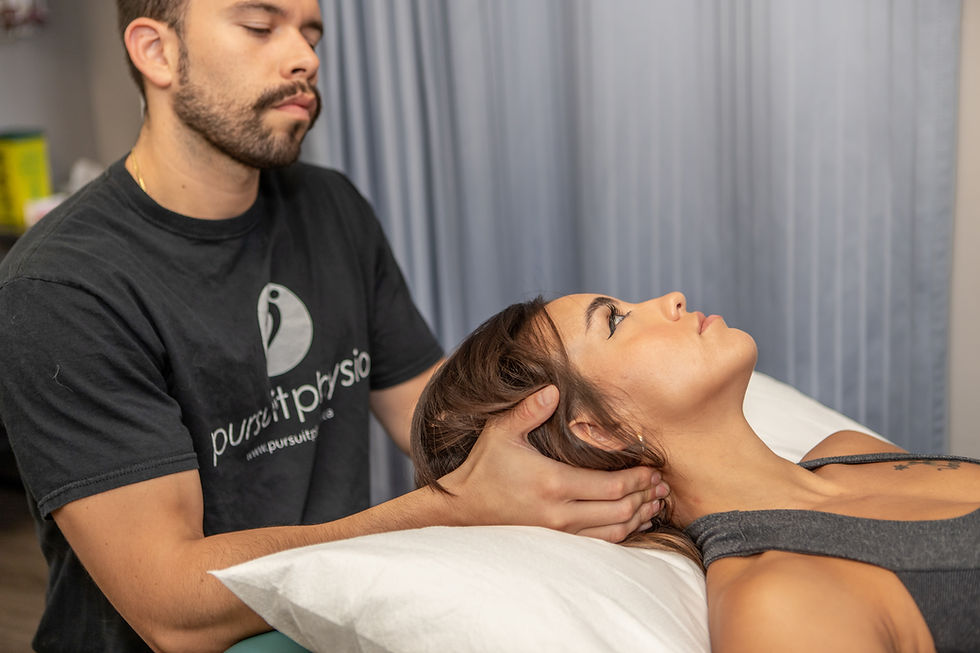
Early on, the priority is reducing the irritation. Gentle manual therapy in Burlington to the neck and upper back can open up the joints and spaces the nerve travels through and ease the protective muscle tension that piles on around an angry nerve. We pair this with positions and gentle nerve mobility work that give the nerve room to glide rather than get tugged, and with clear education on which movements to favour and which to ease off for now.
Where a strong muscular component is guarding the area, medical acupuncture can be a useful adjunct. Javier teaches medical acupuncture to other health professionals at McMaster University, so at Pursuit it is used precisely and where it earns its place, alongside hands-on care and exercise rather than instead of them.
Building a Neck That Holds Up
Hands-on work settles a nerve down. Loading keeps it that way. Our exercise prescription for cervical radiculopathy progresses from gentle range and nerve-gliding work in the early phase toward strengthening the deep neck muscles, the shoulder blade stabilizers, and the upper back, so the whole system shares the load instead of dumping it on one cranky nerve root. The program starts where you are and progresses as your symptoms retreat up the arm and back toward the neck, which is exactly the pattern we want to see.

What to Expect at Your First Appointment
Your first appointment at Pursuit is a full hour, one-on-one with Javier, a registered physiotherapist. No assistants, no double booking, no being passed off. That hour covers a thorough history, a complete neurological and physical assessment to pin down which nerve is involved, an honest explanation of what is driving your symptoms and how long recovery tends to take, and the start of treatment the same day. You leave understanding your problem, not just carrying a diagnosis.
Five Ways to Ease a Pinched Nerve Today
Find your relief position. Resting the hand of the affected arm on top of your head often eases nerve symptoms. It confirms the diagnosis and gives you a genuine break from the pain during a flare.
Keep moving within comfort. Gentle, frequent neck movements that do not spike the arm symptoms keep things mobile. Fully resting a sore neck usually makes it stiffer and slower to settle.
Ease off the aggravators for now. Long stretches with your head tipped back, prolonged overhead work, and sleeping in the position that reliably flares you are worth pausing while the nerve calms down.
Sort out your sleep setup. A supportive pillow that keeps your neck neutral, and experimenting with arm position, can be the difference between a wrecked night and a decent one while you recover.
Do not panic about the arm. Tingling and aching along the arm are the nerve being irritable, not the nerve being destroyed. Understanding that alone tends to turn the volume down, and the research backs the optimism.
When to See a Physiotherapist
If neck pain with arm symptoms has stuck around beyond a week or two, keeps flaring, or comes with tingling, numbness, or weakness down the arm, it is worth having properly assessed rather than waiting it out and hoping. Early, accurate care shortens the road and catches the rare case that needs a different pathway. We see patients from Burlington, Millcroft, Aldershot, Waterdown, Oakville, Milton, and Hamilton, and virtual appointments are available for follow-ups when getting to the clinic is the hard part.
Ready to get to the root of it?
If a pinched nerve in your neck is sending pain down your arm and wearing on your sleep and your patience, book a one-on-one assessment at Pursuit Physiotherapy in Burlington. We will find out which nerve is involved and build a plan to settle it.
#201-4125 Upper Middle Road, Burlington | (905) 331-8993


Comments