
The Stiff Neck That Won't Go Away: What Actually Works for Neck Pain

Updated: Aug 21
What Is Mechanical Neck Pain?
It shows up on a Monday morning. You slept fine, did nothing unusual, and now you can barely shoulder check on the drive to work. Or it builds slowly, a nagging ache that creeps up by mid-afternoon at your desk and follows you home. If you are searching for neck pain treatment in Burlington, you are in very good company: research estimates that up to 70 percent of people will deal with neck pain at some point in their lives. At Pursuit Physiotherapy, neck pain is one of the most common problems that walks through our door, and one of the most treatable.
Most neck pain is what clinicians call mechanical neck pain. That means the pain comes from the joints, muscles, and other structures of the neck itself, and it changes with movement and position. It is not caused by a fracture, an infection, or a pinched nerve sending pain down your arm. It is your neck telling you it is irritated, sensitive, and not coping with what is being asked of it.
Why Necks Hurt
Patients often want to know exactly which structure is at fault. The honest answer is that with mechanical neck pain, pinpointing a single guilty tissue is rarely possible, and rarely necessary. What matters more is understanding what loaded the neck beyond what it could handle. Common contributors include:
Sustained positions. Long stretches of desk work, driving, or looking down at a phone. It is not that any one posture is dangerous. It is the hours spent without moving that necks dislike.
A sudden strain. An awkward night of sleep, a heavy lift, a quick head turn, or a whiplash injury from a car accident or sports collision.
Stress and poor sleep. Long-term stress, anxiety, and low mood are well-established risk factors for neck pain. Tension shows up in the neck and shoulders more than almost anywhere else.
Age-related changes. Disc and joint changes on imaging are extremely common, including in people with no pain at all. They are a normal part of life, not a life sentence.
Deconditioning. A neck and upper back that have not been challenged in years simply have less capacity when demand goes up.
In our clinic, the most common story we hear from patients across Burlington is some combination of the above: a demanding desk job, a stressful season of life, and then one small trigger that tips the neck over the edge.
Signs and Symptoms
What Mechanical Neck Pain Feels Like
Aching or sharp pain in the neck that changes with movement or position
Stiffness, especially turning to one side or first thing in the morning
Pain that spreads into the top of the shoulders or between the shoulder blades
Muscle tightness through the upper trapezius and base of the skull
Headaches that start in the neck. If that sounds familiar, we wrote a full post on headaches that start in your neck.
When It Might Be More Than a Sore Neck
Pain, pins and needles, numbness, or weakness travelling down the arm can mean a nerve in the neck is irritated. That is a different problem with a different treatment plan, and it is one of the first things we test for. Rarely, neck pain needs urgent medical care rather than physiotherapy: pain after significant trauma, fever, unexplained weight loss, progressive weakness, or problems with balance and coordination all warrant seeing a doctor promptly. Screening for these is part of every assessment we do.
What the Research Says About Neck Pain Treatment
For a condition this common, you would hope the research is clear on what works. A 2024 randomized controlled trial published in the Journal of Orthopaedic and Sports Physical Therapy compared two of the most popular approaches head to head.
Researchers randomly assigned 78 patients with mechanical neck pain to receive either manual therapy plus exercise or dry needling plus exercise over seven treatment sessions. Both groups improved. But the manual therapy plus exercise group did significantly better on every outcome at every checkpoint, and they were still holding their gains three months after treatment ended, while the needling group's improvements faded. Pandya J, Puentedura E, Koppenhaver S, Cleland J (2024). Journal of Orthopaedic and Sports Physical Therapy, 54(4), 267-278.
Both groups performed the same five neck and shoulder blade exercises, so exercise was the shared foundation
The manual therapy group received joint manipulation and mobilization of the neck and upper back
Only the manual therapy plus exercise group maintained improvements in pain, disability, and function at the three-month follow-up
This lines up with European clinical practice guidelines, which recommend exercise and manual therapy as the core of neck pain care. Hands-on treatment combined with the right exercise is not old-fashioned. It is what the evidence keeps pointing back to.
How Physiotherapy Treats Neck Pain in Burlington
At our Burlington physiotherapy clinic, neck pain treatment is built on that evidence, adapted to the person in front of us rather than a one-size-fits-all protocol.
Getting the Diagnosis Right
Before anyone gets treated, we figure out what we are treating. That means testing your neck joint by joint and level by level, checking the nerves that travel into your arms, assessing the endurance of the deep neck muscles that support your head, and looking at how your upper back and shoulder blades move. It also means asking about your work, sleep, stress, and activity, because the research is clear that these drive neck pain as much as any joint does.
Hands-On Treatment, Chosen Carefully
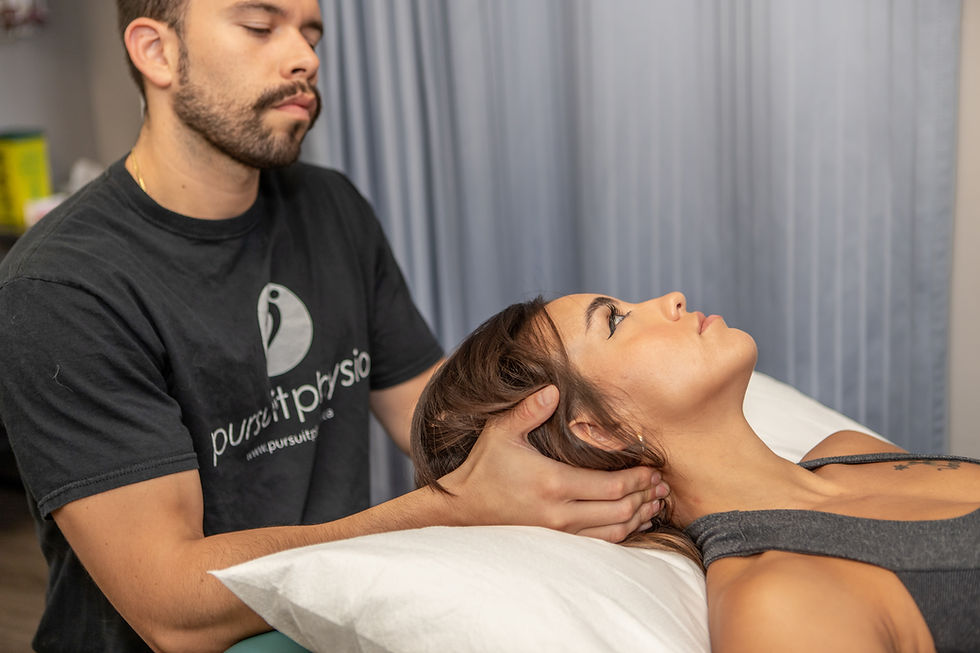
When testing points to stiff, irritable joints and tight muscle, manual therapy is usually where we start: specific joint mobilizations through the neck and upper back, and soft tissue work through the muscles that guard and grip when the neck is sore. One thing worth knowing is that a 2024 systematic review found that manipulating the upper back works just as well for neck pain as manipulating the neck itself. So if the idea of having your neck cracked makes you nervous, good news: we can get the same result with gentler, lower-risk techniques, and we often do.
A systematic review and meta-analysis of randomized trials found that cervical manipulations are not superior to thoracic or cervicothoracic manipulations for improving pain, disability, or range of motion in people with neck pain. Carrasco-Uribarren A, et al. (2024). Musculoskeletal Science and Practice.
For necks with a strong muscular component, medical acupuncture can be a useful addition. Javier teaches medical acupuncture to other health professionals at McMaster University, so needling at Pursuit is precise and used where it earns its place, as an adjunct to hands-on care and exercise rather than a replacement for them. The research above is exactly why we frame it that way.
Exercise That Builds a Neck That Can Cope
Manual therapy calms a neck down. Exercise keeps it that way. Our exercise prescription for neck pain typically targets the deep neck flexors that support your head, the middle and lower trapezius muscles that anchor your shoulder blades, and general mobility through the neck and upper back. These are the same movement targets used in the trial above, and they are trainable at any age. The program starts where you are and progresses as your neck does, whether your goal is a pain-free workday in Burlington or getting back to the gym without bracing for it.

What to Expect at Your First Appointment
Your first appointment at Pursuit is a full hour, one-on-one with Javier, a registered physiotherapist. No assistants, no double booking, no being handed off to a machine in the corner. That hour covers a thorough history, a complete physical assessment, an honest explanation of what is driving your neck pain, and the start of treatment the same day. You leave knowing what is going on and what the plan is.
Five Ways to Help Your Neck Today
Move more often, not just better. Set a timer and change position every 30 to 45 minutes at your desk. Frequent movement beats hunting for the one perfect posture.
Keep turning your head. Gentle, frequent neck rotations and side bends within comfort keep the joints moving. Resting a sore neck completely usually makes it stiffer.
Check your screen setup. Top of the monitor around eye level, and bring your phone up instead of dropping your head down for long stretches.
Take sleep and stress seriously. They are two of the strongest predictors of neck pain persisting. A consistent sleep routine and regular exercise help your neck as much as your mood.
Use heat for comfort. A warm shower or heat pack can settle protective muscle tension enough to let you move, which is the real goal.
When to See a Physiotherapist
If your neck pain has stuck around for more than a week or two, keeps returning every few months, limits your shoulder checks while driving, or comes with arm symptoms like tingling or numbness, it is time to have it properly assessed. Waiting rarely helps, and neck pain that becomes persistent gets harder to shift. We see patients from Burlington, Millcroft, Aldershot, Waterdown, Oakville, Milton, and Hamilton, and virtual appointments are available for follow-ups when getting to the clinic is the hard part.
Ready to get to the root of it?
If a stiff, painful neck is wearing down your workday, your sleep, or your patience, book a one-on-one assessment at Pursuit Physiotherapy in Burlington. We will find out what is driving it and build a plan to fix it.
#201-4125 Upper Middle Road, Burlington | (905) 331-8993


Comments