
Headaches That Keep Coming Back: What Your Neck Has to Do With It

Updated: Aug 21
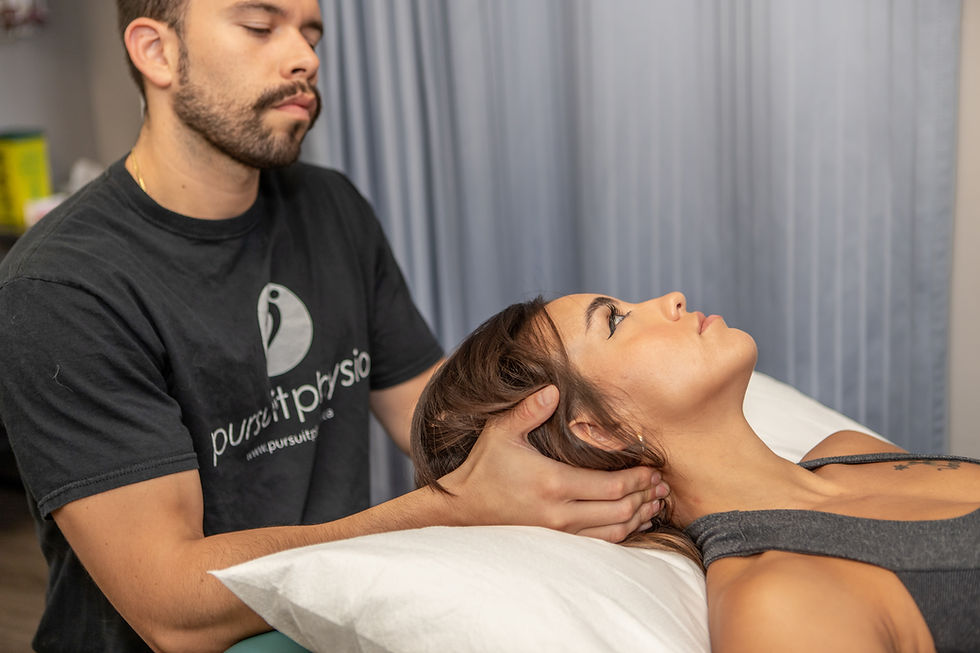
The Headache That Keeps Coming Back
It starts as a dull ache at the base of your skull, creeps up over one side of your head, and settles in behind your eye. You drink some water, take something for it, and get on with your day. Then it comes back. If that cycle sounds familiar, you are far from alone, and finding the right headache treatment in Burlington starts with a question most people are never asked: is your neck part of the problem? At Pursuit Physiotherapy, headaches connected to the neck and shoulders are among the most common and most misunderstood problems we assess.
Headaches are staggeringly common. Research estimates that roughly half of the world's population deals with some form of headache disorder. Most people manage them with medication alone, and for the occasional headache that is perfectly reasonable. But when headaches show up week after week, medication is treating the symptom while the driver, which often sits in the joints and muscles of the upper neck, goes unaddressed.
Not All Headaches Are the Same
Before any treatment makes sense, you need to know what type of headache you are dealing with. The three most common types we assess in our Burlington clinic are:
Tension-type headaches: The most common headache in the world. Usually felt as a band of pressure on both sides of the head, often building through the workday. Long desk hours, stress, and tension through the neck and shoulder muscles are frequent contributors.
Migraines: A neurological condition, not just a bad headache. Typically one sided, throbbing, and often paired with nausea or sensitivity to light and sound. Many people with migraine also have significant neck pain, which is part of why the two get confused.
Cervicogenic headaches: These are secondary headaches, meaning the pain is being referred from a problem in the neck, most often the joints and muscles of the upper cervical spine. The head hurts, but the neck is the source.
The distinction matters because the most effective treatment is different for each type, and they can overlap in the same person. Plenty of patients from Burlington and Oakville arrive at our clinic having spent months treating the wrong headache type.
Signs Your Neck Is Part of the Problem
What a Neck-Related Headache Tends to Feel Like
Pain that starts at the base of the skull or upper neck and spreads up over one side of the head
Headaches triggered or worsened by neck positions: long hours at a desk, driving, or looking down at a phone
Neck stiffness or reduced neck movement that shows up alongside the headache
Headaches that can be reproduced or eased when the upper neck joints are examined
A history of neck strain or whiplash before the headaches began
When It Is Probably Something Else
Some headaches need medical attention, not physiotherapy. A sudden, severe headache unlike anything you have felt before, a headache with fever, confusion, weakness, vision changes or slurred speech, or a new headache after a blow to the head all warrant urgent medical care. Part of our job is recognizing when a headache is not musculoskeletal and directing you to the right care quickly.
What the Research Says About Manual Therapy for Headaches
For years, headache care has defaulted to medication. That default is being challenged. A systematic review and meta-analysis of randomized controlled trials compared manual therapy to medication or placebo in people with tension-type headache, migraine, and cervicogenic headache.
Across the included trials, manual therapy techniques (including joint mobilization, soft tissue treatment, and trigger point work) produced greater improvements in quality of life than pharmacological care or placebo for people with tension-type headache and migraine. The authors concluded the findings support manual therapy as an adjunct treatment alongside exercise and education. Falsiroli L, Rafanelli M (2019). Current Pain and Headache Reports, 23(10).
Two honest caveats, because we would rather give you the real picture than a sales pitch. First, the quality of the underlying studies was mixed, so these results should be read as promising rather than definitive. Second, part of why this matters at all: relying on painkillers for frequent headaches carries its own risk, including medication overuse headache, where the treatment itself starts perpetuating the problem.
How We Approach Headache Treatment in Burlington
Headache treatment at our clinic is built around one principle: figure out what is actually driving your headaches before treating them. That is where physiotherapy in Burlington done properly differs from a generic protocol.
Getting the Diagnosis Right
Here is something most clinics will not tell you: not every headache comes from the neck. Research on people with chronic headache has found that a large proportion have no meaningful neck muscle or joint dysfunction at all. If your neck is not the driver, six months of neck exercises will not fix your headaches. Our assessment tests your upper cervical joints, neck muscle endurance, and movement patterns specifically to determine whether your neck is contributing, and how much.
Hands-On Treatment and Medical Acupuncture
When the neck is involved, treatment usually combines joint mobilization of the upper cervical spine with soft tissue work through the neck, shoulders, and base of the skull. Many of our headache patients also respond well to medical acupuncture, which Javier teaches to other health professionals at McMaster University. Needling techniques targeting the suboccipital and neck-shoulder muscles can be a useful tool when headaches have a strong muscular component.
Exercise That Matches Your Actual Impairments
A randomized controlled trial of women with chronic headache found that a progressive neck and shoulder exercise program nearly halved headache frequency over six months, from about 4.5 days per week down to 2.4. Improvements in headache intensity and duration were modest, and the authors stressed that selecting patients who actually have neck impairments is key to getting results. Rinne M, et al. (2023). Clinical Rehabilitation.
That is exactly how we use exercise prescription for headaches: targeted strengthening and endurance work for the deep neck and shoulder blade muscles when testing shows a deficit, plus general aerobic exercise, which has good evidence for reducing headache intensity and frequency on its own.

What to Expect at Your First Appointment
Every assessment at Pursuit is a full 60 minutes, one-on-one with Javier, a registered physiotherapist. No assistants, no double booking, no rushed ten minute exam. We map your headache history and pattern, screen for the red flags that need medical referral, test your neck thoroughly, and tell you honestly whether physiotherapy is likely to help your specific headache type. You leave knowing what kind of headache you are dealing with and what the plan is.
Five Things You Can Do About Your Headaches Today
Break up your desk time. Set a timer and change position every 30 to 45 minutes. Sustained postures load the upper neck more than any single so-called bad posture does.
Get your heart rate up. Regular aerobic exercise, even brisk walking along the Burlington waterfront a few times a week, has solid evidence for reducing headache intensity and frequency.
Audit your sleep setup. A pillow that forces your neck into an awkward position for eight hours is a common and very fixable contributor.
Track the pattern. Note when headaches start, where they start, and what you were doing. The pattern often points straight at the driver, and it makes your assessment far more productive.
Watch the painkiller frequency. Using pain medication for headaches more than a couple of days per week can lead to medication overuse headache. If you are there now, it is worth a conversation with your doctor or pharmacist.
When to See a Physiotherapist About Your Headaches
If headaches are showing up more weeks than not, if they start in your neck or at the base of your skull, if they are clearly tied to desk work or driving, or if you are steadily using more medication just to function, it is time to have your neck properly assessed. We see patients from Burlington, Millcroft, Aldershot, Waterdown, Oakville, Milton, and Hamilton at our clinic, and for busy desk workers we also offer virtual physiotherapy appointments for follow-up and exercise progression.
Ready to get to the root of it?
If recurring headaches are chipping away at your work, your sleep, or your patience, book a one-on-one assessment at Pursuit Physiotherapy. We will tell you what type of headache you are dealing with, whether your neck is involved, and what to do about it.
#201-4125 Upper Middle Road, Burlington | (905) 331-8993


Comments